
2025 was a fantastic year for investors, even if it didn’t always feel that way at the time. Global stocks delivered strong returns, with many major asset classes finishing well into double-digit territory.
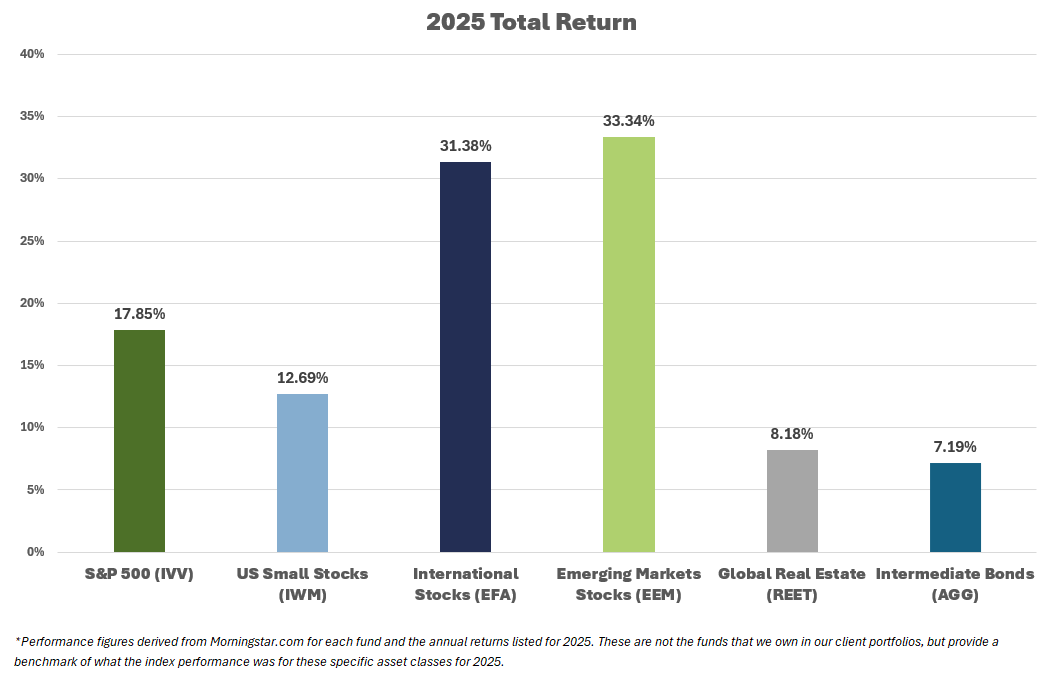
While US stocks continued their strong run, the real standout story was the performance of international and emerging markets, which each soared over 30%. This was the most they have outperformed the S&P 500 since 1993!
We know many investors gravitate toward US stocks exclusively, but there's a reason we maintain roughly 35% of the stock portion of our portfolios in international and emerging markets. This allocation isn't because we got lucky with 2025's performance, or because we're chasing last year's winners. It comes from our data-driven approach, which is designed to optimize long-term outcomes. At the heart of our investment philosophy is a core belief in the power of global diversification: owning thousands of great companies from around the world, rather than limiting ourselves to just one country or sector.
Before we talk more about investment performance, bear with me for a quick aside, I promise it relates!
Jessica and I are huge Buffalo Bills fans, and like most long-time NFL fans, we’ve learned that following a team can be an emotional experience. In many ways, being a sports fan isn’t all that different from being an investor.
Over the course of a season, fans ride a week-by-week emotional roller coaster. Injuries happen. Close games are lost. Momentum swings. One week you’re convinced this is the year, and the next you’re ready to fire everyone and start the rebuild!
I saw this play out this season with my brother, who is a die-hard Denver Broncos fan. Over time, he’s adopted a more pessimistic approach, keeping expectations low to avoid future heartbreak. If you follow the NFL at all, you know the Broncos exceeded expectations this year. They won their division, finished with the #1 seed in their conference, and were one of the last four teams standing in the playoffs. If it weren’t for the recent injury to their starting QB, they almost certainly would be playing in the Super Bowl this year!
Looking back from today, it’s easy to focus on the successful outcome and forget how uncomfortable parts of the season actually felt at the time. The Broncos started the year 1–2 after a couple of heartbreaking losses. Fans were frustrated. Confidence was low. I still remember my brother texting me after the second loss: “We’re not making the playoffs this year” and “I’m ready to fire everyone.”
Fortunately for the Broncos, fans don’t get to make the coaching and roster decisions. If they did, the team likely wouldn’t be where it is today.
While you may not care too much about the Broncos or even the NFL, the emotional swings fans experience closely parallel with what investors feel as they ride the ups and downs in the stock market and economy. The critical difference is that investors do get to make decisions in real time. And those decisions, especially during moments of stress or disappointment, will have a lasting impact on their long-term outcomes.
Much like the Denver Broncos’ season, the investment experience in 2025 was excellent in hindsight, but it didn’t always feel that way in real time. There were bumps, bruises, and stretches where optimism was hard to come by. In investing, that’s not the exception. It’s the norm.
The chart below shows how $100 invested on January 1, 2025 in a globally diversified stock portfolio, would have fluctuated throughout the year, alongside some of the major events we were living through at the time.
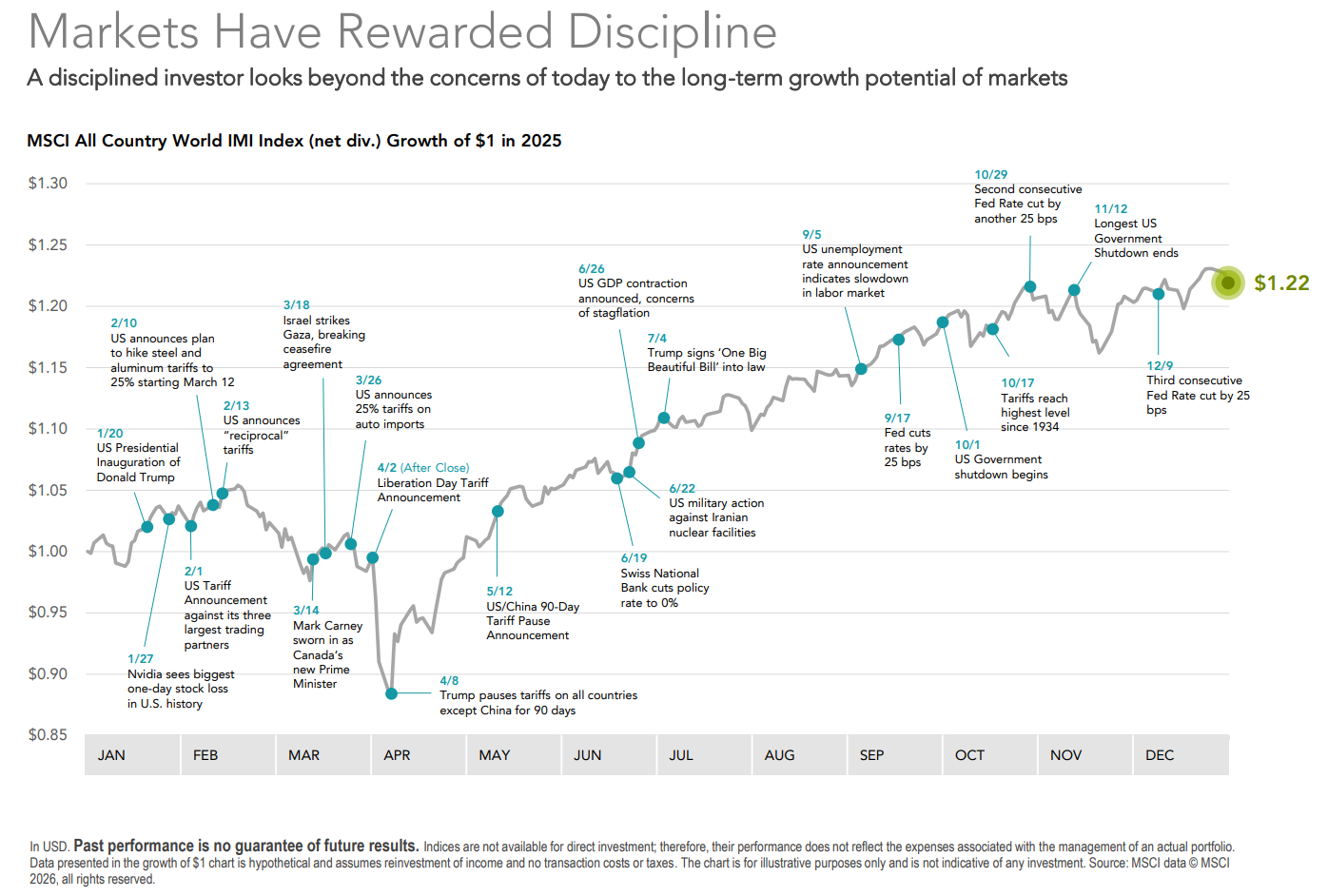
It can be hard to remember now, but rewind back to April and May. Markets were rattled by uncertainty around U.S. tariff announcements and adjustments, ongoing unrest in the Middle East, and growing concern about the broader economic outlook. During that stretch, we heard from many of our own clients who were understandably uneasy about where things were headed.
The S&P 500 fell nearly 20% over the seven-week period leading up to April 8th. Headlines were negative. Confidence was fragile. Many investors felt a strong urge to step aside and “wait things out.” At the time, that concern felt completely reasonable. When markets are volatile and uncertainty is high, the instinct to protect what you’ve built is deeply human.
And yet, just when things felt the worst and uncertainty was at a fever pitch, markets turned.
From April 8th through the end of the year, a globally diversified stock portfolio gained more than 36% (referencing Vanguard Total World Stock – VT). That climb came despite continued tariff uncertainty, shifting interest rates, questions about AI-driven gains, and even the longest government shutdown in U.S. history.
This is the part that’s easy to forget! Strong market years rarely come with clear signposts along the way. Volatility isn’t a sign that something is broken. It’s simply the price investors pay to earn higher long-term returns.
When markets feel uncertain, the urge to “do something” can be overwhelming. Stepping to the sidelines can feel like a way to regain control. The challenge is that markets don’t wait for clarity, and recoveries often begin when confidence is still low. Market timing isn’t a single decision. It requires getting two decisions right: when to get out, and when to get back in. That second decision is where things tend to break down.
Some of the market’s strongest days and weeks tend to occur shortly after sharp declines, when uncertainty is still high and optimism is in short supply. Investors who move to cash during periods of fear often miss these rebounds, and getting back in once things “feel better” usually means buying at higher prices. By the time things feel “comfortable” again, much of the recovery has often already happened.
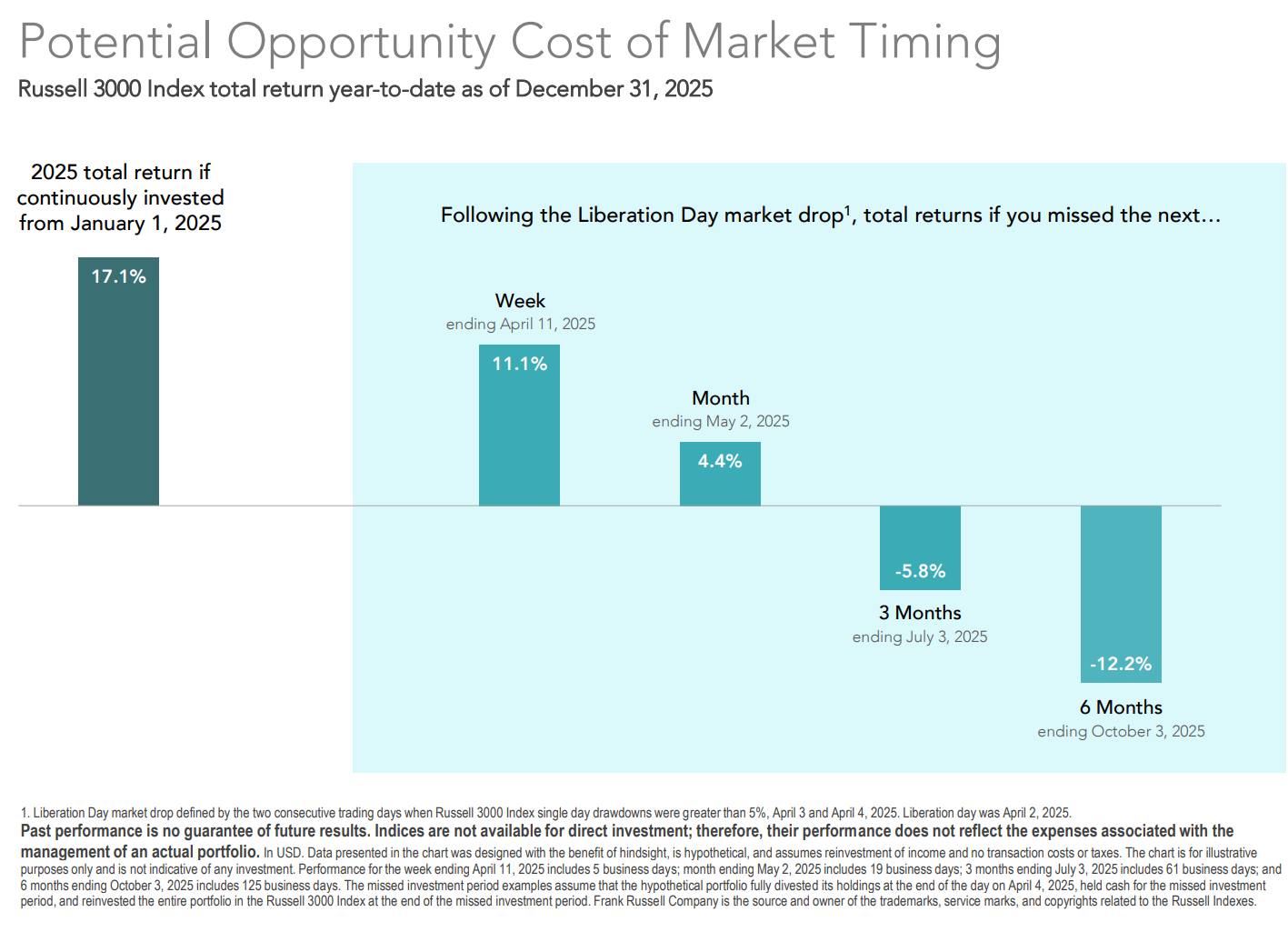
2025 offers a clear example. Imagine an investor who felt uneasy during the volatility in early April and decided to move to cash following the tariff announcements on April 2nd. At the time, that decision may have felt sensible. But as the chart below shows, the cost of sitting out even briefly was significant. Missing the wrong week reduced returns by roughly 6%, and remaining on the sidelines for six months resulted in performance nearly 30% lower than if the investor had stayed fully invested.
This is why we never encourage clients to try to time the market. It’s incredibly difficult to get right, and even when one decision works, the next one often doesn’t. Over time, the odds are stacked against anyone trying to predict the short-term twists and turns.
Avoiding market timing isn’t just about staying invested during scary moments. It’s also about managing expectations after periods of strong performance. Both mistakes, trying to sidestep volatility and assuming recent returns will continue, tend to show up after long bull markets.
One of the biggest risks after a year like 2025 isn’t fear. It’s expectations.
Markets have delivered exceptionally strong returns in recent years! The past three alone produced high double-digit gains, well above what long-term investors should expect on a sustained basis. History tells us that periods like this are eventually followed by more muted returns and, at some point, a meaningful bear market.
To be clear, this is not a prediction that 2026 will be a bad year. In reality, we aren’t predicting anything at all. We don’t know when the next downturn will occur, and we don’t need to. A sound investment strategy is built with the assumption that both good markets and difficult ones will happen.
Unrealistic expectations can be just as costly as market timing. When investors assume recent returns will persist, they are more likely to take on too much risk, drift from diversification, or abandon discipline when markets pull back. When that happens, fear and frustration often lead to decisions that are hard to undo.
Market declines are not a sign that a plan has failed. They are part of the plan. There are no free lunches in investing. Again, periodic declines are the price investors pay for long-term growth and the opportunity to build lasting financial wealth.
The best way to stack the odds in your favor isn’t to predict what comes next. It’s to set realistic expectations, stay diversified, and remain disciplined when markets inevitably test your resolve.
We can’t control market outcomes, but we can control our expectations and our behavior. Over time, that matters far more.


