
Wow! What a week!
We were welcomed into the weekend with headlines about the "AI Wipeout," the AI trade unwinding, and a sea of red in the stock market. This week was the toughest of the year, capping off a general decline across much of the market over the past few weeks. In fact, the S&P 500 just had its first seven-day losing streak since the 2020 pandemic. 😬
If you're feeling nervous right now, you're not alone! But this market volatility looks very different depending on who you ask. How much this decline has stung completely depends on how you're invested (and how closely you've been checking your account). Someone who went all in on the Nasdaq or a handful of AI and tech stocks has had a much rougher few weeks than someone who owns the global stock market.
For our clients, that difference has been a real cushion. Because your portfolios are spread across thousands of companies around the world, in every industry and size, they've held up much better than a portfolio that only owns the Nasdaq or a few big tech names. Still not fun, but a far smoother ride.
If you're a Vitality Wealth client, this one's to help you keep perspective. And if you aren't a client yet and you're not quite sure your plan is built for weeks like this, or you hold a lot of individual stocks, we hope it helps you too.
The news loves to lead with the scariest number it can find. Right now, that's the pullback in some of the AI stocks that were market favorites just a couple months ago. While they get all the attention, the overall market has held up much better.
Here's how far a few well-known companies have fallen from their previous highs, compared with different areas of the overall stock market (as of November 20, 2026):¹
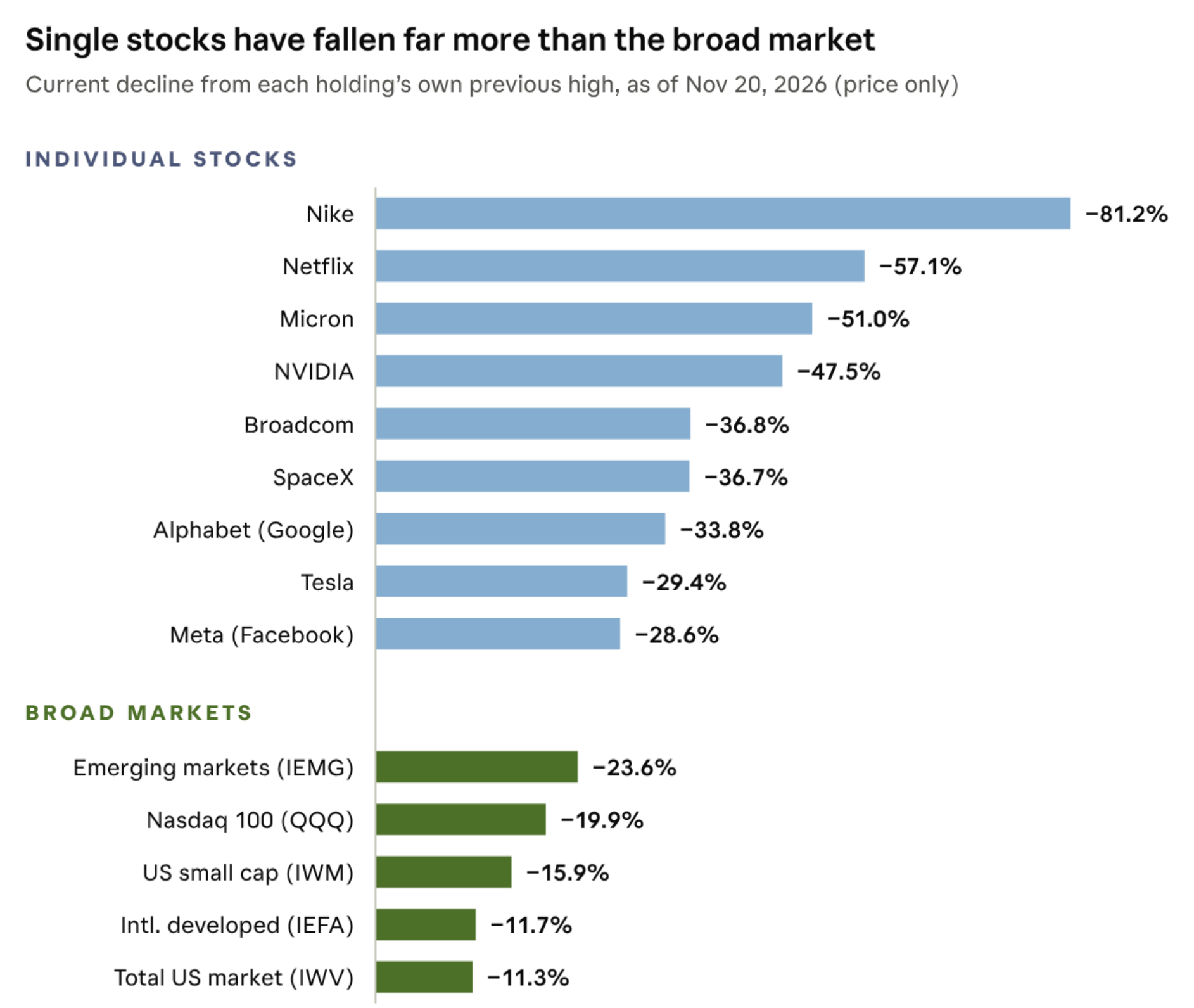
Said differently, owning one company is a much bumpier ride than owning the whole market. Some of the largest, most successful companies in the world are down 30% to 50%, and a few names are down even more. The broad US market is down about 11%.
Here in Boise, a lot of us know Micron well. Whether you hold Micron RSUs or just follow the stock, a 51% drop in one company is a good reminder of why no single company should carry too much of your plan, even if you work there.
That's the whole point of diversification. When you own thousands of companies around the world, no single company, industry, or country can sink your portfolio/retirement. Your account probably doesn't look great this week, but if you're diversified, it doesn't look anything like Micron or NVIDIA!
Each figure is that holding's current decline from its own previous high, and those highs happened on different dates. Price returns only, dividends excluded.
Drawdowns measure the fall from the very top (all-time highs), which is the most dramatic way to look at a decline. Zoom out to the full calendar year, and the picture looks a lot better! The markets below are common benchmarks for the areas of the market we invest in, not the specific funds we use with clients. Pay special attention to the green bars, which show each market's year-to-date change. And keep in mind that total returns are actually a bit better than what you see here, because these numbers don't include dividends.
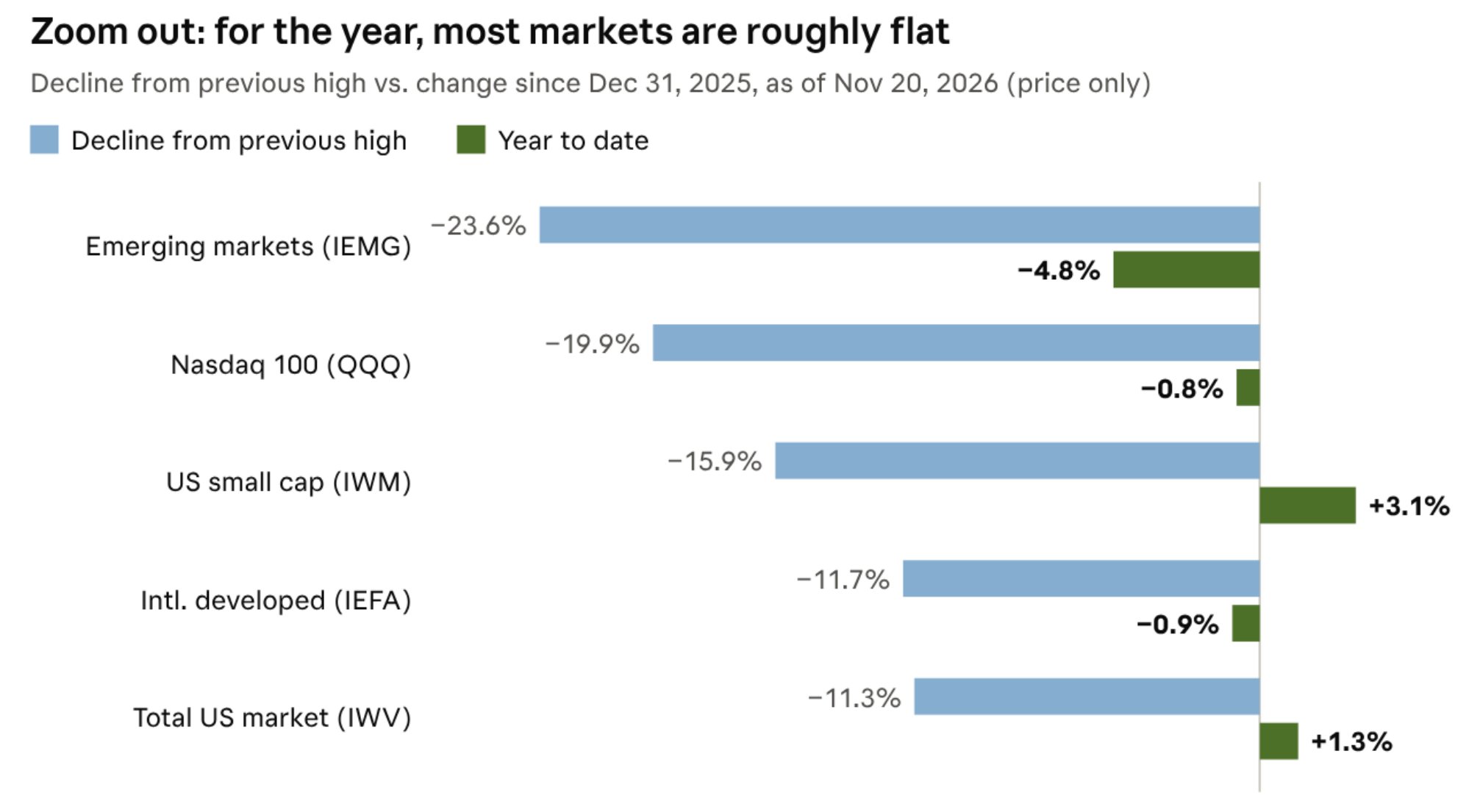
Through the first two-thirds of 2026, markets were having an above-average year. That cushion absorbed much of the recent drop, so the broad markets above range from about -5% to +3% for the year as of November 20th.¹
Giving back gains still hurts. But for a diversified investor, this decline has mostly erased this year's above average run-up, not years of progress.
Times like these are thoroughly unenjoyable, but they're not at all unexpected. If you've been investing long enough, you know declines are a regular part of the ride.
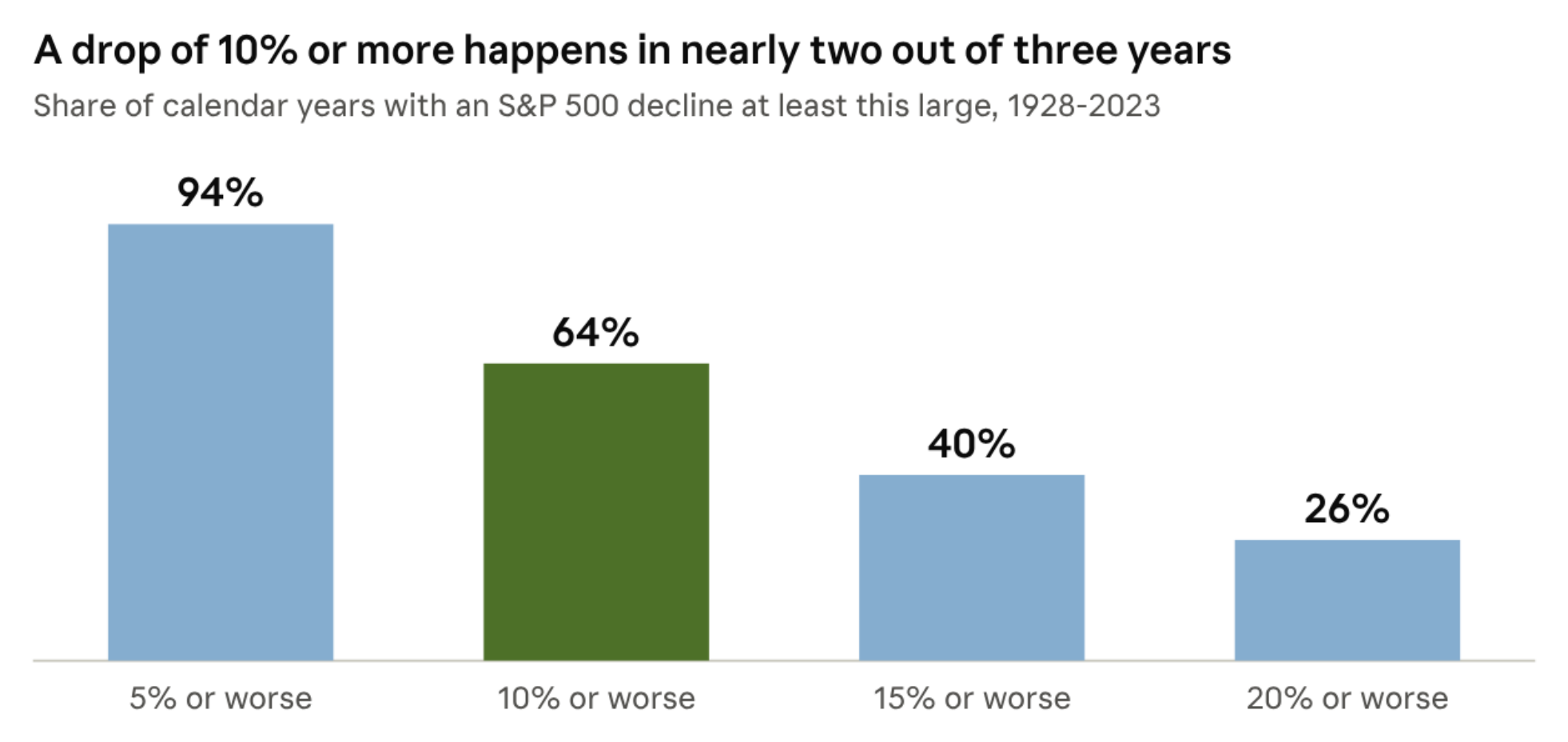
From 1928 to 2023, the S&P 500 fell 10% or more at some point during the year in 64% of years.² It fell 20% or more in 26% of years, roughly one year in every four.
In investing, market volatility is not the exception. It's the norm.
Risk and return will always be related. Like it or not, there are no free lunches in investing. (Trust us, we've looked! 😅)
The US stock market has been an efficient wealth generation machine, averaging roughly 10% a year over the long run.³ The "cost" to get that return gets paid in market valleys like this one, where investors have to stomach the short-term volatility. That short-term pain is the reason stocks have historically rewarded the people patient enough to sit through it.
We've been here before, and recently. In early 2020, the pandemic sent the S&P 500 down over 30% in about a month. In 2022, rising inflation and interest rates pushed it down over 20%. Both felt awful, and very scary, in the moment. Both are now in the rearview mirror for investors who stayed in their seats, and the market has since gone on to new all-time highs.
There's an old saying we love: "The stock market is the only market where things go on sale and all the customers run out of the store."⁴
With Black Friday a week away, think about it this way. If you're still working and adding to a diversified portfolio in your 401(k), IRA, or brokerage account every month, you're buying thousands of great companies at lower prices than you were a few weeks ago. Same great companies, smaller price tag. And unlike Black Friday at the mall, nobody has to fight over the last TV at 5 a.m. And if you have excess cash on the sidelines, now is a great time to consider putting it to work. One important caveat: the great buying opportunity is true of the whole market, not necessarily any individual company.
This isn't a prediction about where the market goes next month or next year. In fact, we aren't predicting anything at all, because any prediction would just be a guess. It's simply a reminder that for long-term savers, a down market can mean something much different than it feels like on the news. We don't know when the market will turn around or when it will hit new all-time highs, but buying the stock market when it's on sale has historically been a winning proposition for long-term investors.
We knew this time would come, because volatile times like this are a feature of investing, not a bug. We couldn't have told you it would happen right now, because frankly, we have zero ability to predict when declines will happen.
It might seem strange to hear that from financial advisors, but it's the truth. And if anyone tells you they can time when to get out of or back into the stock market, don't walk away, RUN away. Timing the market requires you to be exactly right twice: when to get out, and when to get back in. The data is clear that it's a fool's errand, and those who try often do far more damage than if they had simply stayed invested.
That's why having the right investment plan must come BEFORE we get into volatile markets. Not everyone should have 100% of their portfolio in stocks. For some people, that number should be closer to 50-60%. For most, it's somewhere in between. The right mix depends on your goals, your timeline, and honestly, how well you sleep at night when the market drops.
To our clients: we remain confident in the long-term plans we've built together with each of you. We built your plan expecting weeks like this one, and we've told you these declines would come since our very first conversations and in just about every review since. Market declines are not a sign that a plan has failed, in fact, they're part of the plan. So, what should you do now?
And as always, if you're feeling nervous and would like to talk through your own situation or portfolio, just reply to this email or reach out anytime. We're always happy to talk and give you our thoughts!
Weeks like this are no fun. Watching your balance drop is hard, no matter how many times you've been through it. Honestly, it can get harder with age, because most of us naturally grow more conservative as we get older.
But it's not unexpected. It's the price of admission for attractive long-term returns.
We can't control market outcomes in the short term, and honestly, we don't need to. What we can do is control our reaction to these events. If you're diversified and have the right plan, the most important thing you can do right now is stay committed and stay in your seat.


